Opet Italic
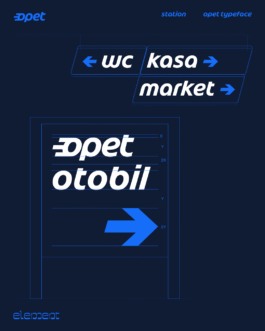
In 2025, we worked closely with Opet to redraw their custom typeface, which is based on their iconic logotype designed by Ivan Chermayeff in 2004.
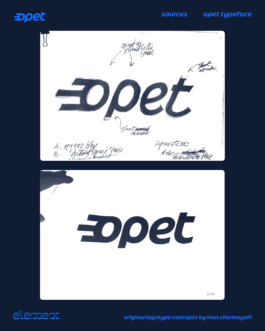
Opet, one of the biggest fuel companies in Turkey, commissioned Ivan Chermayeff in 2000 to create a new branding. As a part of the branding, a custom typeface was developed out of Opet's new logotype. Chermayeff's team turned the hand-drawn logotype into vector drawings and extended the character set in Adobe Illustrator, then handed digital drawings to Agfa Monotype in order to turn them into font files.
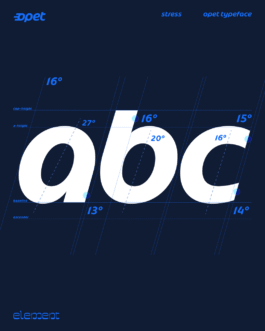
Opet's team shared the original drawings and the design assets with us. Instead of relying on the shapes of the existing font, which fail to meet many current technical standards and are essentially an interpretation of Chermayeff’s original designs, we began examining the original drawings. We’ve started to map out a plan for everything we want to improve—from curve quality and proportions to inconsistencies amongst shapes and the italic angle.
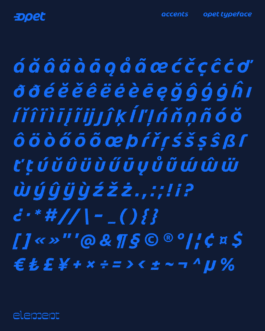
We expanded the character set for wider language support, engineered the font files, and added a couple of new design features.
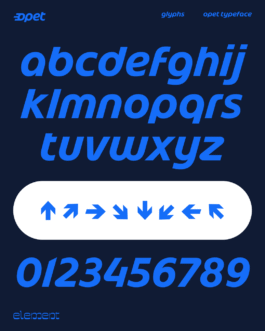
We slightly reduced the x-height to achieve wider proportions. That allowed us to reduce the curve tension on round shapes, as they were rather pointy/egg-shaped on the drawings. Reducing the x-height also gave a bit more presence to the ascenders and descenders.
As we followed the humanistic touch of the original design, we couldn’t help but make the terminals of glyphs such as s, 2, f more prominent.
Improvements on the general inconsistencies, italic angles, and the curve quality meant a fresh look that harmonises the calligraphic roots with digital drawing.
In Opet’s daily use, figures carry a great deal of information, so their proportions and spacing require close attention. We aligned them with the ascenders so they naturally flow within text.
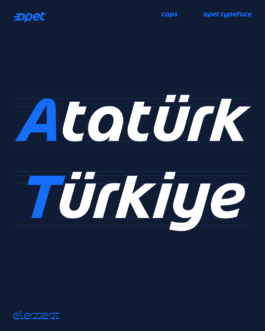
Although the font consists entirely of lowercase letters, the capital A and T were designed for certain commonly used proper nouns.
Since Opet operates across a wide and varied technical infrastructure, compatibility was central to the brief. The font files had to work not only in contemporary design environments, but also in older systems still used in the field. We made sure that every font file works seamlessly almost anywhere, from Figma on a MacBook to a kiosk running Windows XP.
From the initial sketches to the typography and engineering, we are thrilled to have taken up the original Opet Italic logo and to have contributed to this iconic design.
Opet Italic
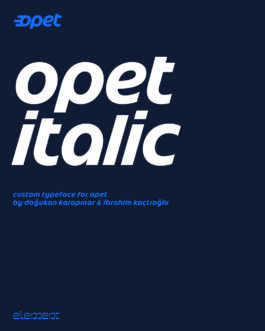
In 2025, we worked closely with Opet to redraw their custom typeface, which is based on their iconic logotype designed by Ivan Chermayeff in 2004.
Opet, one of the biggest fuel companies in Turkey, commissioned Ivan Chermayeff in 2000 to create a new branding. As a part of the branding, a custom typeface was developed out of Opet's new logotype. Chermayeff's team turned the hand-drawn logotype into vector drawings and extended the character set in Adobe Illustrator, then handed digital drawings to Agfa Monotype in order to turn them into font files.
Opet's team shared the original drawings and the design assets with us. Instead of relying on the shapes of the existing font, which fail to meet many current technical standards and are essentially an interpretation of Chermayeff’s original designs, we began examining the original drawings. We’ve started to map out a plan for everything we want to improve—from curve quality and proportions to inconsistencies amongst shapes and the italic angle.
We expanded the character set for wider language support, engineered the font files, and added a couple of new design features.
We slightly reduced the x-height to achieve wider proportions. That allowed us to reduce the curve tension on round shapes, as they were rather pointy/egg-shaped on the drawings. Reducing the x-height also gave a bit more presence to the ascenders and descenders.
As we followed the humanistic touch of the original design, we couldn’t help but make the terminals of glyphs such as s, 2, f more prominent.
Improvements on the general inconsistencies, italic angles, and the curve quality meant a fresh look that harmonises the calligraphic roots with digital drawing.
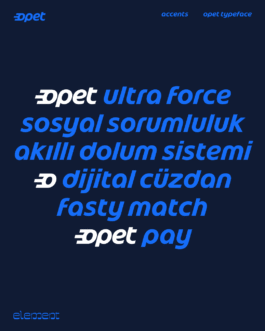
In Opet’s daily use, figures carry a great deal of information, so their proportions and spacing require close attention. We aligned them with the ascenders so they naturally flow within text.
Although the font consists entirely of lowercase letters, the capital A and T were designed for certain commonly used proper nouns.
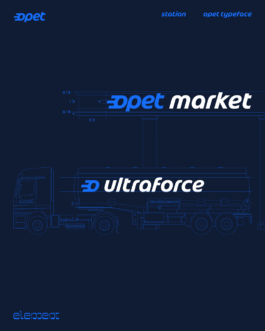
Since Opet operates across a wide and varied technical infrastructure, compatibility was central to the brief. The font files had to work not only in contemporary design environments, but also in older systems still used in the field. We made sure that every font file works seamlessly almost anywhere, from Figma on a MacBook to a kiosk running Windows XP.
From the initial sketches to the typography and engineering, we are thrilled to have taken up the original Opet Italic logo and to have contributed to this iconic design.